






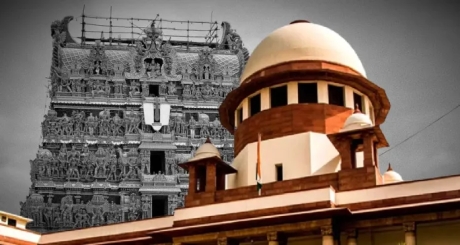
 If one wants to understand Hinduism, one has to look at it both as a religion and a way of life. That is the uniqueness of Hinduism. That it can be both. – Swami Brahmavidananda
People are fond of saying that Hinduism is not a religion. It’s a way of life. I don’t know who sowed this idea into people’s minds. Everybody has their own way of life and so by repeating again and again that Hinduism is a way of life, no one has become much wiser.
Any religion must have an idea of God. It must have an idea of who or what the individual is. It must have a religious goal and methods for reaching that goal. If one considers all this, definitely Hinduism has a very refined idea of God or Ishwara.
Hinduism has a very clear-cut understanding of the individual as not different from Ishwara at its highest level of understanding. And there is also a method to reach that goal of moksha, self-knowledge, God realisation, whatever you want to call it.
Therefore, by all these standards, Hinduism is definitely a religion. At the same time since a Hindu’s whole way of life is geared to reach this goal, traditionally speaking, and hence is not limited to just one day in a church or a mosque or a temple it is a very joyful effort, put in 24/7 and done consciously. Even those who don’t understand what moksha is about, participate in many cultural forms which highlight that all that is here is sacred. Much of the way of life has different elements of the culture that embody the highest vision of oneness.
If one wants to understand Hinduism, one has to look at it both as a religion and a way of life. That is the uniqueness of Hinduism. That it can be both.
Not only that, it has something for everybody, nobody is excluded. You start where you are and you reach the goal. Therefore, you may find hundred million viewpoints, hundred million practices. Nobody is expected to do all of them. But with the help of your guru, you are supposed to pick up what is appropriate for you at your present stage and move forward in your understanding. – Free Press Journal, 8 February 2024
› Swami Brahmavidananda Saraswati is the founder of Aarsha Vidya Foundation.
Filed under: india | Tagged: hinduism, ishwara, religion, sanatana dharma, way of life | Comments Off on Is Hinduism just a way of life? – Swami Brahmavidananda






 BHARATA BHARATI